Alert! Alert! Lightning has struck in the world of art and science!
Lightning on the Cheyenne Ridge Roger Edwards, Photograph www.stormeyes.org
The question: Does art enhance science and math…and vice versa?
The answer: Yes! There are correlations between a Rembrandt portrait and a mathematical model…between Vincent van Gogh’s Starry Night and a gamma-ray telescope.
Art enhances our understanding of science, particularly the science of weather. We respond in new ways to Earth’s atmosphere and climate through the window of art.
Proof of this was shouted from the roof-tops, or rather from a towering glass atrium, as a cyclone of artworks from around the globe converged upon a mega art exhibition…the first National Weather Center Biennale in Norman, Oklahoma!
Flooded Car Lot Tom Berenz, Oil on panel www.tomberenz.com
The NWC Biennale was the brain child of three very accomplished whirlwinds in the professional art world and one top-notch scientist.
Alan Atkinson, Ph.D., Curator, The National Weather Center Biennale
Ghislain d’Humieres, Director, Fred Jones Jr. Museum of Art
Erinn Gavaghan, Executive Director, Norman Arts Council
Dr. Berrien Moore III, Director, National Weather Center
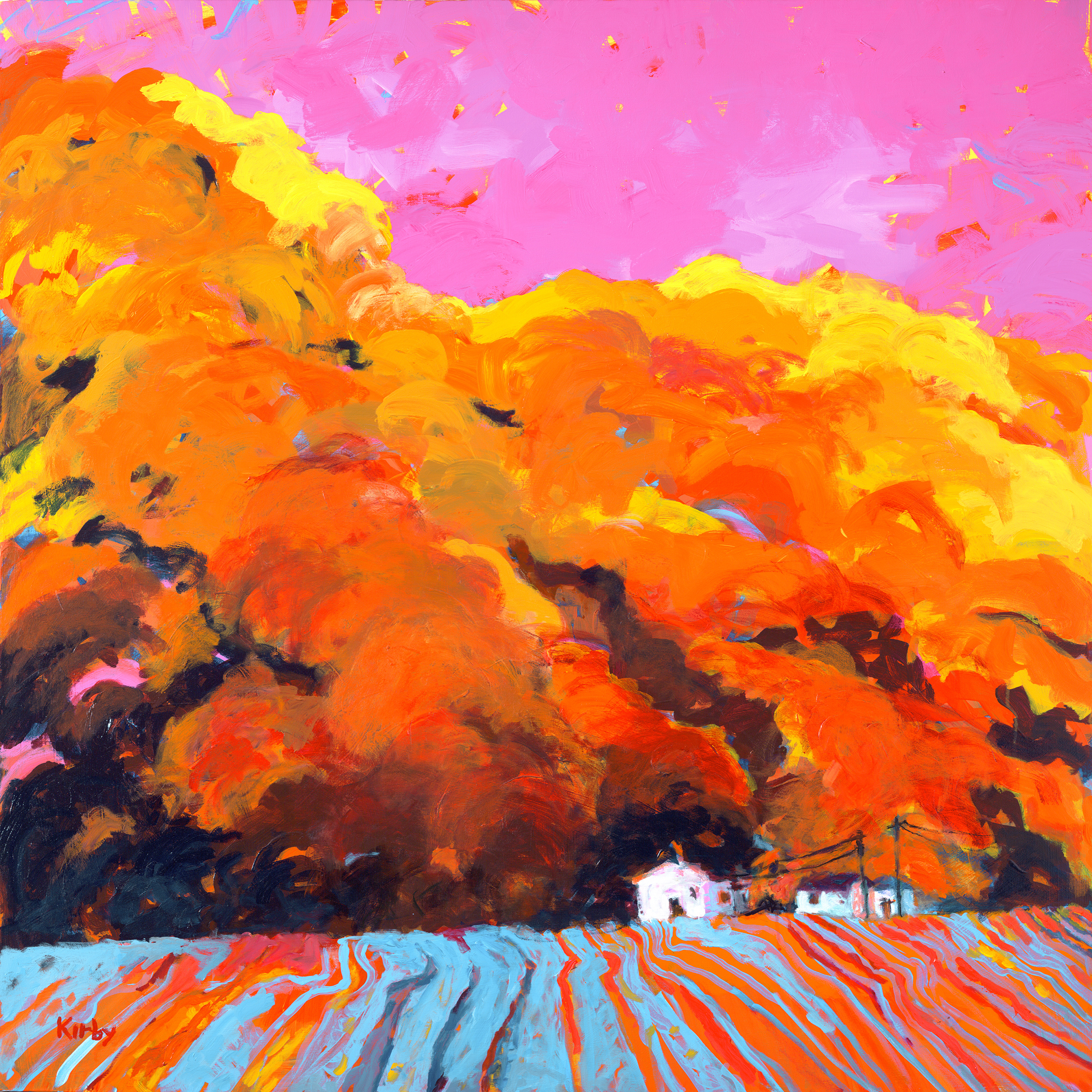
Trouble Cometh Kirby Kendrick, Acrylic on canvas www.kirbykendrick.com
The challenge to artists was to create a work expressing the dynamic image of weather and its impact on the human experience.
Yes! We can be surrounded by great design…as we work, travel, practice our religion, and just live.
__________________
ART IN WORK
China Central Television Headquarters Beijing, China, 2012 Rem Koolhass, Architect
This astonishing 54-story tower and it’s smaller companion building lean and loom like science-fiction creatures poised to stomp all over the surrounding Beijing business district.
Lots of glass and lots of see-through levels…some people in these spaces will be in constant eye contact but will rarely meet!
___________________
ART IN TRAVEL
The Galatic Suite SpaceResort Xavier Claramunt, Architect
Galactic Suite is the first-ever hotel designed for outer space.
Space travelers (I mean guests) are launched aboard a rocket ship. They pass the sound barrier and dock in the spaceship (a.k.a. resort), which is orbiting 300 miles above the Earth.
After settling into their own private module (well, not exactly settling, as Velcro suits will be provided allowing guests to attach themselves to the walls for dining and viewing), guests will orbit the Earth 15 times in 3 days.
Fifteen sunrises and sunsets…what a view!
The cost per person for a three-day-stay at Galactic Suite is $4.4 million. The hotel already has 38 bookings.
__________________
ART IN RELIGION
La Sagrada Família "Holy Family" Catholic Church Barcelona, Spain Antoni Gaudí, Architect
La Sagrada Família is Antoni Gaudí’s unfinished masterpiece. Construction on this church began in 1882 and continues to progress.
It is impossible to know how much the church has cost so far and will cost to finish…and no one has ever known how long it will take.
“My client,” said Gaudí, meaning God, “is not in a hurry.”
Antoni Gaudí, Spain’s most famous architect and National Treasure, was fatally hit by a tram in 1926. Private donations have enabled construction of the Sagrada Família to carry on to this day.
__________________
ART IN LIVING
Carton House, 2002 Oskar Leo Kaufmann, Architect
Artistic dignity for our people who actually have to sleep in cardboard on the street.
The Last Supper, c. 1495 Wall painting, Leonardo da Vinci
Leonardo da Vinci captured the moment in which Jesus makes the staggering announcement that he will be betrayed by one of His disciples. This is the last supper they will share.
He is indeed betrayed by Judas Iscariot that same night.
He is crucified by Pontius Pilate.
He rises from the dead three days later.
And the world is changed forever.
Artists have expressed their own versions of The Last Supper for over 500 years.
Their interpretations are profound, enlightened, mysterious, and humorous.
The Sacrament of the Last Supper, 1955 Oil on canvas, Salvador Dalí
The Last Supper, 1940 Oil on canvas, Frida Kahlo
Jesus Is My Homeboy: Last Supper, 2003 Photograph, David LaChapelle
“Anybody who sees and paints a sky green and pastures blue ought to be sterilized.” Adolph Hitler
_______________
Stormtroops Advance Under Gas, 1924 Otto Dix
“Any art that does not glorify war is forbidden.” Nazi propaganda
_______________
Sitting Girl, 1910 Ernst Kirchner
“Garish colors and contorted poses of the female body are evidence of a depraved society.” Nazi propaganda
_______________
German art changed spectacularly after 1920. No longer did artists paint the classical Greek model.
The horrors of World War I, the terrible economic depression, prostitution, the chasm between the rich and the poor…all were bitterly protested in art.
German artists used bright garish colors, awkward poses and harsh brush strokes to shock the viewer with Germany’s tragic plight.
German Expressionism was born!
As a young man Adolph Hitler was refused admittance to art school in Vienna, Austria, on the basis of his lack of artistic ability. He never recovered from the rejection.
Hitler denounced German Expressionist artists and their extremely colorful paintings as “degenerate.” They were evidence of a pollution in the Aryan strain. The artists who produced them were fired from their teaching positions, their works were removed from museum walls, and they were forbidden to paint again.
Some of these “degenerate” artists escaped to other countries, many of their works were hidden for years or secretly smuggled to America, and many, many works were burned.
Today German Expressionism is considered a momentous time in German art history, the paintings are back on museum walls and “degenerate” art is celebrated over the world.
Outsider Art:
Naive…visionary…never been in an art school or gallery…disturbing images…
DELIGHTFUL!
_______________
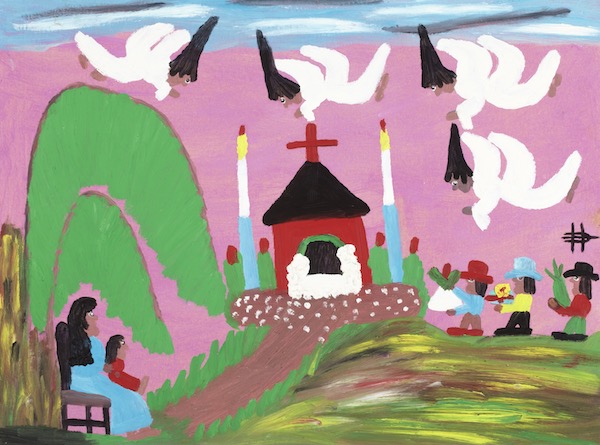
Wash Day, 1950 Cementine Hunter Oil on pasteboard.
First impression of Clementine Hunter’s paintings: charming, quaint, life on the plantation.
But, look deeper into these child-like paintings of picking cotton, picking pecans, washing clothes, baptisms and funerals.
Even though she was born in 1886, twenty years after the Civil War, segregation and oppression of the blacks was still rampant. These paintings are gentle images of this oppression.
What a story! Clementine spent much of her life working on a plantation in Louisiana and only attended school for ten days, never learning to read or write. While she was working as a house servant, an artist visiting the plantation left some discarded brushes and tubes of paint. She became intrigued and used the brushes to “mark a picture, or a window shade.” Clementine Hunter’s career as an artist began.
Often referred to as the black Grandma Moses, Northwestern State University of Louisiana granted her an honorary Doctor of Fine Arts degree when she was 100 years old.
_______________
Untitled Henry Darger
Henry Darger’s story is heartbreaking but he left the world a treasure trove of art.
Tragedy found Henry Darger early and often. When he was 4 yrs old, his mother died. Unable to care for him, Darger’s father placed him in an orphanage. Labeled a troublemaker, the young Darger was moved from institution to institution. At 16, Darger ran away and for the next 64 years he lived alone in a rented room and worked as a janitor in Chicago.
Darger died at 81. His landlords cleaned out his room and made a startling discovery: alone in his room, Darger had created hundreds of beautiful, large paintings illustrating an epic fairytale (15,000 pages) he had written over 60 years.
A brilliant artist, hidden from the world in the guise of a lonely janitor, Henry Darger has become internationally known and is represented in major museums throughout the world.
_______________
Jesus is my Airplane, 1970 Sister Gertrude Morgan
Jesus Christ The Lamb of God and His Little Bride, 1960 Sister Gertrude Morgan Crayon and ballpoint pen on paper.
Sister Gertrude Morgan (1900–1980) was a poet, a preacher, an artist, and a singer who loved Jesus. She called Jesus her husband, her doctor, and her airplane (yes, airplane), and claimed to have met with him in visions throughout her mid and later life.
Born on a farm in Alabama, in 1900, Sister Gertrude left school after third grade so that she could help her family with the farm work.
Preaching the gospel tirelessly in the streets of New Orleans, Sister Gertrude founded an orphanage and ministered to the sick and inmates of Orleans Parish Prison for years.
Later in life, she said she had had a revelation that she was to be the “little bride of Christ.” This calling she took with great seriousness, dressing solely in white garments for the rest of her life.
After this revelation, Sister Gertrude’s paintings were little figures of herself in a white bridal gown standing beside a pudgy little Jesus wearing a tuxedo. Other images pictured her and Jesus in an airplane flying around heaven. She was adamant that her paintings were divinely inspired and indeed, perhaps they were.
Sister Gertrude died in 1980, at eighty years of age. Her paintings have been exhibited and celebrated in prestigious museums such as the American Folk Art Museum and the Philadelphia Museum of Art.
“Jesus is My Airplane,” sold to a private collector for $20,700.
Girl with a Pearl Earring, c. 1665 Johannes Vermeer
Did we just call out her name? Is she turning to us to whisper a secret? We lose ourselves in her gaze, and all of a sudden we feel a quickening of the heart…a charge of energy.
We are in the presence of a masterpiece. Girl with a Pearl Earring.
Considered one of the most talented painters in the Dutch Golden Age, Vermeer was a genius in enhancing the sense of vibrancy and mystery through his paints.
How did he achieve the intimacy of this smile?
Look closely at the young girl’s mouth. Two small white dots on either side of her mouth, echoes the highlights in her eyes and the light on her pearl earring.
Voila! The young girl’s half smile is enlivened!
How did Vermeer achieve the delicious colors of the turban, the cloak?
The rich blue of her turban: The artist procured the blue rock, lapis lazuli, from Afghanistan traders. He then hand-ground the hard rock to powder making that incredible ultramarine blue.
And her vibrant cloak: Yellow flowers gathered and boiled making that special golden earthy color.
But knowing the “how” dims not at all our reverence for the painting. Returning to that face with the liquid eyes and sensual smile, we once again bask in the delight of being in the presence of a true and timeless MASTERPIECE.
Girl with a Pearl Earring: Dutch Paintings From the Mauritshuis can be seen in a rare traveling exhibit at: